
Cancer Council Queensland reports that Queensland has the highest rates of skin cancer in the world, with around 3,000 melanomas and 133,000 non-melanoma skin cancers diagnosed across the state each year. Nationally, two in three Australians will be diagnosed with skin cancer in their lifetime, and over-exposure to UV radiation causes around 95 percent of melanomas.
Here is the part that surprises people. Despite those numbers, there is no national skin cancer screening program in Australia. Nobody is going to post you an invitation the way BreastScreen or the bowel screening program does.
And the clinical guidance is more specific than most people expect. The RACGP’s preventive activities guidelines do not recommend routine scheduled skin checks for people at average or below-average risk. Scheduled checks are recommended for people at high risk, and opportunistic checks for those at above-average risk.
So the useful question is not “should everyone get a yearly skin check”. It is “which group am I in, and what should I be doing”.
Who benefits most from a scheduled skin check
Your risk is higher than average if several of these apply:
- Fair skin that burns before it tans, or freckles easily
- A large number of moles, roughly 50 or more, or moles that look unusual
- A previous skin cancer, of any type
- A first-degree relative who has had melanoma
- A history of sunburn, particularly blistering sunburn in childhood
- Years of outdoor work or regular outdoor sport
- Past solarium use
- A weakened immune system, including after an organ transplant
- Being over 40, and particularly being a man over 40
If a few of those describe you, it is worth discussing a skin check schedule with your GP rather than waiting until you notice something.
What everyone should be doing, regardless of risk
Getting to know your own skin costs nothing and is the single most useful habit here. The Skin Cancer College Australasia promotes a simple framework called SCAN your skin, which asks you to look for spots that are:
- Sore and have not healed within about six weeks
- Changing in size, shape, colour or texture
- Abnormal, meaning it looks different to the spots around it
- New, especially if you are over 40
If a spot meets any of those, book an appointment. Do not wait for a scheduled check, and do not wait to see whether it settles down. Most of what we look at turns out to be harmless, and that is a good outcome, not a wasted appointment.
Sun protection in Queensland is a year-round job
Cancer Council advises sun protection whenever the UV Index reaches 3 or above. In Queensland, the UV Index sits at 3 or above all year, which is why the usual seasonal thinking does not apply here. You can check the daily UV times for the Gold Coast through the SunSmart Global UV app or the Bureau of Meteorology.
The five forms of protection remain the ones worth building into a routine: covering up with clothing, sunscreen, a broad-brimmed hat, shade, and sunglasses that meet the Australian Standard.
What a skin check at the practice involves
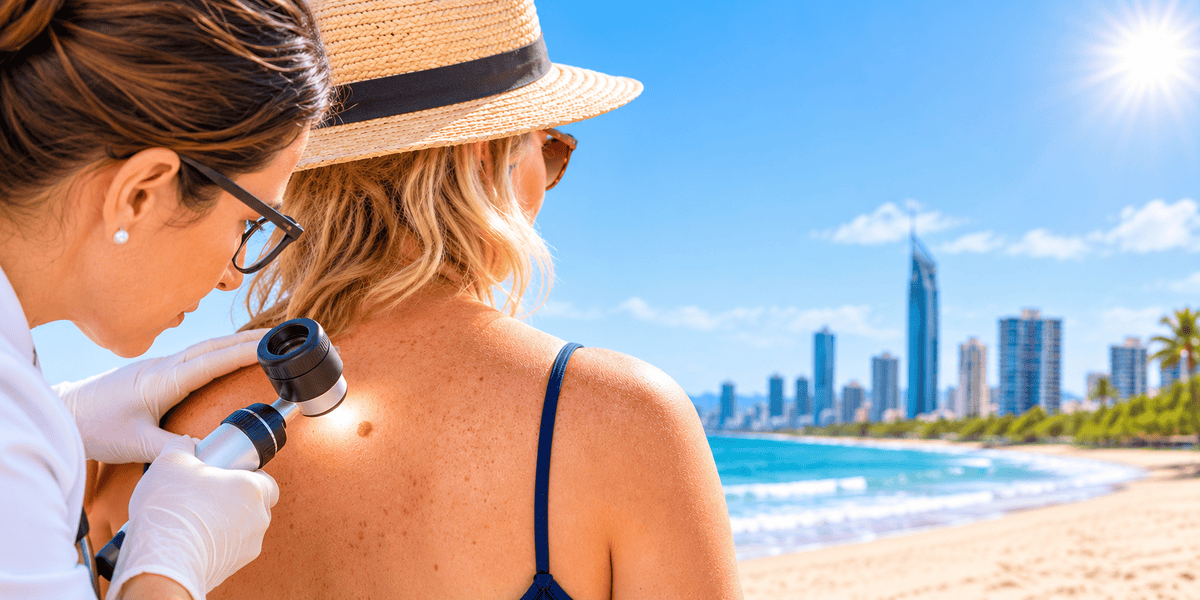
A skin check is a dedicated appointment. Your GP examines your skin, using dermoscopy to look closely at anything of interest, and discusses your personal risk factors and what follow-up interval makes sense for you. If something needs removing or biopsying, that can often be arranged at the practice, since minor skin procedures are performed here.
Wear or bring clothing that is easy to change out of, and remove nail polish if you would like your nails checked. Tell your GP about any spot you are specifically worried about at the start of the appointment, rather than at the end.
Book if it applies to you
If you have a spot that is sore, changing, abnormal or new, book an appointment now. If several of the risk factors above describe you, speak with your GP about the right skin check interval.
Book an appointment with Carrara Family Practice. Call (07) 5594 4118 or book online. Bulk billing available. Ask our team about billing when you book.
National Skin Cancer Action Week runs from 15 to 22 November, and it is a reasonable prompt to work out which group you are in.